Thursday, July 31, 2014

Sandman Overture #3: A Roundabout Review

Sandman Overture #3
By Neil Gaiman and 
J. H. Williams III


What is in a Dream?

When I was first introduced to Morpheus, it was thirty-two issues into Neil Gaiman's vast story. As each issue progressed forward, I also searched the back issues, buying each one and enjoying the story he weaved that much more. After seventy-five issues, the song was done and now after two decades, the melody lingers on. 

I visited a comic shop in Virginia while taking a few days off from work and there on the new release rack was Neil Gaiman's latest. The first issue was a great opening salvo and the second issue took off running; but the third issue gives us Hope. Dream of the Endless is off to see the City of Stars and in doing so, he intends to find his killer and to make sure he doesn't do murder him again.

J.H. Williams III has never illustrated a comic book better than this one. The panels are vibrant, the colors are rich, and the detail steals the story away to new heights. Dream travels with Dream; one is the version we knew and the other is the Dream we don't. Also, for the first time we see Dream laugh...and in the very end we see the stars are coming out. 

As dreams are lucid after we awake, they slip away much like this issue describes. I am left with a feeling of nostalgia after only moments of closing the comic. I can't wait until the next issue and wish the series was limited like the first one, for seventy-five issues, not the six that are already scheduled.

4 out of 5 Stars

Wednesday, July 23, 2014

Amazing Spider-Man #4: a Roundabout Review


Amazing Spider-Man #4

Written by Dan Slott
Pencilled by Humberto Ramos


Spoilers spoilers spoilers

The Long of it...

I always loved the romance between MJ Watson and Peter Parker. I grew up with the flirtations and was rewarded with issue #290, when Peter proposed. Annual #21 was a jackpot issue, with two covers to choose from. I never thought about buying both. 

Joe Quesada changed all that, treating decades of continuity with wild abandon, giving Peter a Brand New Day.  And ever since Dan Slott took over, I've truly enjoyed the title. Superior Spider-Man was exceptional, but having Mr. Parker back is like wearing comfortable shoes. 


Issue #4 of the Amazing Spider-Man never made it home unread. On my public transit commute, I realized I couldn't wait. I pulled the comic out of the brown paper bag and engulfed myself. I was finally getting more than a few pages of a character rumored to change Peter's life forever. I was expecting Silk to be another Speedball or Alpha, but Dan made her so much more. Here was a character who was built right into Peter's origin as Spider-Man. The story was even mixed with another tale from years ago with Ezekiel and Morlun, but don't tell Marvel that, they might start over again with a number one.

Cindy Moon was a classmate of Peter Parker,  and before you ask, "Why are we just hearing about her in 2014 and not 1963?", I will tell you it is because of Original Sin. If Thor could have a sister, why couldn't the radioactive spider bite one more person?


Ezekiel hid Cindy away from Morlun. She practiced her abilities in secret as Peter used his in public. She's stronger, faster, and has even developed a more advanced power set, including barbs in her webs; yes,"her" webs, but it doesn't stop there. Peter's Spider sense reacts to Cindy in a whole different manner; it attracts him to her, much like I imagine his spider tracers do after flicking them on his prey (super-villains). 

I'm going to skip the part about the Black Cat and the part where we find out Morlun is alive. I'm even going to skip where Silk freaks out as Peter mentions that Morlun was killed...and killed again. Silk is so enraged with this news that she quickly lands one on Peter...twice; once with her hand, and on the final page with the final panel, once with her lips!


Suffice it to say, not only was this the best Spider-Man comic I have read in a while, it was the best comic book I have read in a long time, period! I think once I get done at work I'm going to read it again.

The Short of it...

Buy it.

5 out of 5 stars 
 
Thanks for reading

Friday, July 18, 2014

Soaring as Captain America

It isn't breaking news, it's everywhere and it started on the Colbert Report.  The Falcon has been announced as the next Captain America. He isn't the first to take the mantle over and I'm sure Steve Rogers will be back. After all, the Winter Soldier more recently accepted the shield after the "death" of Rogers, and in the eighties when Steve was "fired", the US Agent had the title and the shield and yet Steve still returned, but what makes Sam Wilson worthy this time around? 

The Falcon was first introduced in Captain America #117 (Sept. of '69), which makes him slightly older than me, becoming the first (Marvel) black "American Super Hero" (remember the Black Panther is African). It wasn't until the following issue that we found out The Falcon was Sam Wilson. Throughout the years Sam was a trusted partner of Steve Rogers, and his portrayal by Anthony Mackie was nothing short of phenomenal in Captain America: The Winter Soldier. The Falcon wasn't some sidekick. He was a partner and a friend, which makes me wonder, was this the reasoning behind Marvel's recent decision to update their Golden Age creation?

In the eighties, Marvel tested the waters with a mini-series by Jim Owsley starring Captain America's most trusted sidekick. This was originally their way to get feedback on whether a regular series should start. If the four-issue limited sold out then the Falcon would fly solo. This never happened and the Falcon continued to be a B-list hero. Sam has proven over and over again that he is true and loyal. Not since Bucky in World War II did someone have Steve Rogers back as well as Sam did. 

In the Ultimate Universe his credentials rival the smartest of Marvel's characters, but back in the 616 universe, Marvel Now started Captain America all over again with new creative teams; beginning with issue one. I tried collecting the title after this new beginning and I quit reading after issue #2. I felt uninspired to continue reading. And now, a few years later, we have Captain America, a 70+ year iconic creation that needs new life. 

I can not think of any character other than Sam Wilson more worthy of the mantle, but I question how able he is. No one can throw a shield better than Steve and catch it after knocking out his enemy. There is a certain Je' ne sais quoi about reverberating an adamantium shield off of someone's skull and having it return to sender. 

Of course, some questions remain. Why is Marvel changing the guard? Are they so desperate for new readers that they hope changing Thor into being a woman will garnish more new readers than alienate old ones? Do they think throngs of little girls will decide to pick up a comic book? With Sam Wilson becoming Captain America, will a larger black audience walk into comic shops asking to read the latest adventures? And now I'm waiting for Jean Paul from Alpha Flight to join the pages of Iron Man so we can find out Tony is bisexual for a larger gay audience. 

My biggest beef with Marvel is not the changing of iconic characters. I'm ok with that. I'm even looking forward to seeing them move in this direction, provided each title is story driven. What I don't like is that even though Sam Wilson is taking over as Captain America, he's not taking over the title. We will have to wait until November 2014 before the "All New Captain America" #1 is released, which is way different than when Tales of Suspense was changed to Captain America with issue #100 instead of issue #1 way back in 1968.

I don't plan on asking how Sam Wilson is worthy of being Captain America because I can't think of any other character who is. But I will ask this....

Who is worthy of being The Falcon?


Thanks for reading

Wednesday, February 19, 2014

Fuse #1

Every week I go to the comic shop. If I'm delayed, it is only by a day. I have my choices picked before I even traverse the twenty some mile distance to my LCS, which is about 15X further than the one closer to where I live. As I walk around the store, grabbing for my weekly addiction, I will try something new once in a while. And Image Comics really wants me to try something new from them this week between the pages of The Fuse #1.

The comic book is fast paced and reads like a good television show feels. I was never one for Mysteries or whodunit shows. I wasn't a fan of Murder She Wrote or Sherlock Holmes, but I remember reading five minute mystery stories in elementary school that had me guessing. To say that The Fuse reminded me of those short stories would be a disservice to Anthony Johnston, it's more like the feeling of reading a mystery and trying to figure it out before the ending reveals all. 

It's only the first issue and some where 36000 km (22,469.362 miles) above the Earth there are some questions that need to be answered, predominantly that enigma that craves to be answered first is why Detective Dietrich decided to relocate to "The Fuse", second who's killing Cabler's, The Fuse's version of homeless, and third do I really have to wait a month for issue #2?

The Fuse was an interesting read, one that I only picked up because Image has continued to impress. This was no exception. I rate this a Very Fine/Near Mint out of a Near Mint.


Thanks for Reading

Sunday, January 12, 2014

The Cost of a Grade

Or Collecting CGC

I might have to start this article with what is CGC? For decades, collectors wanted to buy the best possible comic book. Originally comic book enthusiasts would clamor for a pedigree because they were of the highest quality. I found out about these sought after collectibles from a list published in my first Overstreet's Price Guide. At one point the OPG was the be all to end all of comic book price gathering amongst trends, recorded sales, and even speculation. Since then, other magazines have come and gone. Wizard and CBG are some examples. 

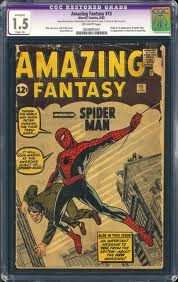
Now with the internet, an up to date price guide is only a few short clicks away. EBay started to change the comic book industry in September of 1995 by allowing others to bid on comic books. A copy of Amazing Fantasy #15 could be found without ever having to leave home and at the price one is willing to pay. In 1999 the industry would greatly change once more, eventually escalating prices. 


CGC is a subsidiary of Certified Collectibles Group, or CCG. Comics Guaranty Company also known as CGC was surrounded by sister companies NGC (1987), SGC (1998), and followed by its younger sibling PMG (2005). CGC officially opened in 2000, but was created in 1999 amongst criticism, after all comic books were meant to be read. If you ask a fan of Marvel Comics who was mainly responsible for the creation of the Marvel Universe, the answer would be a resounding Jack Kirby and Stan Lee. If you ask who was responsible for CGC, the answer might be a little more difficult to come by.

Mark Salzberg, owner of the Certified Collectibles Group deciding to add grading comic books to his repertoire scoured the industry and found in more than humbled whispers that Steve Borock was the man to talk to. Steve was a knowledgeable collector originally setting up booths as a kid at local conventions. Over the years he acquired an “eye” to attain the best comic book possible and owned many of them. His love for the hobby had him questioning Mark, thinking this venture was only a way to scam the less knowledgeable; he met up with him anyway. 

After a dinner, set up by Steven Fishler, Steve Borock was convinced that it wouldn't destroy the hobby he loved, but level the playing field. Joining CCG was simply meant to be, but he couldn't do it alone. Some names that also show up when researching the origin of the most controversial topic to come along in comics since Dr. Frederick Wertham, would be Mark Haspel, Paul Litch, and later on Chris Friesen.

Originally starting with three graders, there were many nights the couch became the sleeping spot of choice for Steve Borock rather than take the trip home; besides, it got very cold in Parsippany, NJ. For CGC to work, a standard had to be created. How many flaws could each grade have? What if the book was restored? Could all three graders agree? Would the industry accept a third party grading company? And could the slab be fixed? These were Steve Borock’s first burdens.

The “slab” was the first problem to overcome. Both holders for NGC and SGC were solidly constructed to not only keep the cards and coins safe, but resistant to tampering. Comic books were a whole different avenue and they were three dimensional opposed to the two dimensions of their collecting counterparts. The sonic vibrations causing the slab to seal were only able to be opened by brute force, such as with a hammer. This could hardly be useful with a comic book.

  
At the 1999 New York Comic Con, the initial submissions were returned after it was realized the first version of holders were just not good enough. The possibility of the comic book being damaged inside what was supposed to protect it was just too overwhelming. Steve Borock wanted something that could protect the item and yet still be opened, if the owner of the comic book decided to read it. Once he was satisfied with improvements of the holder, CGC opened their doors and began grading on January 4th, 2000 with "Walt Disney Comics and Stories #1".

CGC doesn't merely slap a numerical grade to it; they also look for hidden defects, color breaks, chips, cracks, and missing pages. They search for tears, ink markings, foxing, water damage, and clipped coupons. There is also married covers, cockling, spine roll, indents, spine creases and in my case, Lucky Charms marshmallow stains. This list is unsurprisingly long. Most of us forget CGC looks for restoration first. I believe a way to protect the average collector was originally the main objective of CGC.  Steve Borock once called the internet the Wild West since you never knew what you were going to get and many times I am sure that was true.

Was that Amazing Fantasy 15 you just purchased over the internet not as good of a deal? Did the seller accurately describe the item or lie? Was it held together by tape? Was a page missing? Are the staples newer than the book? In fact a comprehensive detailed check and analysis on each comic book is performed by CGC. Two preliminary graders look over a comic book, each entering data without the other's knowledge. Once this is finished a senior grader looks over the same comic book and assesses it. Once the final grade is entered, all three entries are visible. If the grades match, the book is passed on to be encapsulated. If it doesn't, the three graders then discuss the condition before the final process.

This of course is for a fee. CGC is a business after all, one with ten plus years under its belt and over two million comic books graded. The cost and time involved is dictated by the tier of service involved. For example, an older Silver Age comic book will cost more to grade than a book just purchased off the shelf. After grading is completed, the book is encapsulated with two layers of protection. The first, or inner layer, is a soft plastic called Barex. CGC considers this as “The Well”. Afterwards this is secured in a thick hard exterior. Archival paper is placed inside the comic book between the front and rear covers to help reduce the damage caused by time.

The degree of restoration, signature placement, damage and numerous other probabilities are just a small amount of what goes into segregating the comic books and clarifying what grade and label a comic book should receive. The most popular and widely used is the Universal Blue Label. A restored book gets purple, CGC witnessing a signature gets yellow, and a restored comic book with a witnessed signature gets a dual color label with purple and yellow. The last label is green for any qualified grades, which deserves an article all by itself. Once in a while a discontinued red label can be found.

In 2007, at Wizard World Philadelphia, I picked up my first two CGC graded comic books. I purchased them originally as a novelty. I first heard of third party grading years before and I thought the idea of encapsulating a comic book away from ever being read again was ludicrous. As I walked around the convention floor purchasing various Daredevil issues to complete a run, almost every dealer had CGC graded comic books adorning their "walls". My curiosity piqued. My thought process changed from “never” to “why not?”

By the end of the show my growing comic book collection now consisted of two universal graded comic books. The first one was a 9.8 copy of Secret War #2 that I procured for $25. The second, also acquired from the same forgotten dealer, was a copy of a Daredevil #90 graded a 9.0 for the same price.  I thought the two that I picked up would be the end of it, and it was, until I walked into a much smaller convention, the Philadelphia Comic Con. It was at this smaller convention my addiction began with the first issue of my favorite title in the coveted 9.8 grade. 

Today CGC is the number one third party grading company for comic books with over two million graded. I predict they will reach four million in less time than it took to reach the first two, especially with the Signature Series popularity constantly growing and auction sites reporting record high sales, but why use CGC? Why have a book graded? Why get it checked for restoration? Is it worth it? And what could it cost?

Steve Borock originally created an idea for an ad still published in the OPG. The advertisement asked if you would buy a house without certification, a diamond, or even a car. And then asks why buy a comic book without the same peace of mind. I believe he meant for older comic books from the Golden and Silver Age and not so much with the newer Copper or Modern age. A new car should be flawless, much like a fresh comic book taken off the shelf. The back issue bin might be a bit more difficult to find a premium looking comic book, especially from the seventies or older.

As much as a car drops in value once removed from the dealership, a comic book has a chance to return on the cost, creating speculation. The craze in the nineties had comic books selling over a million copies each, on a few select issues. No such comic book has revisited those numbers and not one of those highly publicized books has yet to pay for a child's college tuition.

As things change, a six month transition period in 2008 occurred, this allowed Mark Haspel to take over the reins, changing from Vice President, a position he had since day one, and becoming the President of CGC. Steve Borock left CGC after this time and is now Senior Consignment Director at Heritage Auctions. In the same press release that announced Steve leaving and Mark taking over, it also announces Paul Litch becoming Vice President and Modern Primary Grader. Steve left knowing that CGC would be in good hands with someone who was there at the beginning with him. In 2011 Mark Haspel left on an extended leave of absence. Paul Litch is still at CGC as Primary Grader.


In the fifties comic books were currency into the world of make believe. A good neighborhood had friends trading them quickly after being read. At ten cents apiece, sales were staggering. I imagine one out of a hundred hoarded them, but with burnings in the fifties sparked by the book “Seduction of the Innocent” of these treasured items, their value seems to be guaranteed, hence why a majority of EC comics sell for hundreds of dollars in the poorest condition. In 1952 an industry high of over a billion comic books sold, that's over fifteen million a week.

Today, comic books are a bit more expensive. Who wouldn't want to purchase the best condition for their comic book collection? Any new comic book placed on the rack of any specialty shop I consider to be "Off the rack Near Mint". Once purchased there should be no problems with it getting a 9.4 if bagged and boarded and sent to CGC. A 9.6 is a meticulously nice book, while a 9.8 is easily the most sought after. Do I dare even mention a Mint 9.9, or its pure perfection counterpart, a Gem Mint, historically marked with a numerical ten?

A CGC 9.8 copy of Harbinger #1 which sold for $2550 in March of 2008, was the first comic book from the nineties to sell for over a thousand dollars in that grade. I heard a Spawn #1 in a 9.9 did the same, but yet to find proof of that transaction. The most popular one now from the same decade is the first appearance of DeadPool. The New Mutants #98 has over 4000 graded (4373), one reaching an incredible 9.9 signed by Rob Liefeld and more recently an unprecedented universal gem mint ten. More keep coming in as one of the most popular books of the modern age, next to the previously mentioned Spawn #1 (3551) and The Walking Dead #1 (1762).


Between 1991 and now The New Mutants #98 became a key comic book much like The Incredible Hulk #181, from the seventies did. The other issues to arise with interest from the same eighties title in a 9.8 are #1 (681), #16 (140), and #87 (2042). Including the three mentioned, issue #98 is probably graded more than the rest of the title combined, including the annuals. Some of these issues have only two graded in a 9.8.  Issue #58 (9.6 SS) and Annual #4 (9.6 SS) do not even have a 9.8 copy on the census, yet. Any of the Non Key issues could be found in any dollar or blowout box, but once graded a 9.8 by CGC those same books could become upward to a hundred dollars; signed a little bit more.

Grading by CGC greatly increases the purchase price of a book, although it does not guaranty it is worth that cost. It only guaranties the grade. There are instances where a comic book not graded by CGC outsells a comic book that was graded by CGC. I personally had many comic books graded purely because what they are worth to me. My New Mutants series is a testament to that. This also begs to ask again why send a book to CGC? Is money the objective? Are you planning to flip the comic book? Is it the pride and joy of your collection? And what can it do for the buyer knowing the grade?

I like CGC because of the community I became part of, but it also allows the buyer to feel comfortable with what they are purchasing, akin to purchasing a pedigree before CGC was created. A gem mint copy of New Mutants #98 sold through ComicLink.com reaching $15,449, a comic book that originally guided in the OPG for $4 in 1999, the same year CGC was stepping into the waters (this was dismissed as a coincidence). The most this comic book could have cost to get graded was the $18 charge for grading, an additional $10 to fast track it, $5 for the invoice fee, and possibly an additional $5 to have them scan it. Add a minimum of $10 for shipping it back to you and you’re looking at $48. Spending that on a non-key comic book priced at $5 is clearly not worth the financial cost.

If you purchased Deadpool’s first appearance when it first came out at cover price the chance of attaining a gem mint, however small, would give you a small profit of over $15,000, if the last recorded price was matched. A 9.9 could gain an approximate $3000 dollar profit, a 9.8 about $300, while a 9.6 could get you $50. Anything less isn't worth the cost of the grade. 

The New Mutants #99, a cover tribute to X-Men #138, would be even less. GPA’s highest recorded price for this book with a signature series 9.8 signed by Rob Liefeld was $125 (Dec 2013). A universal 9.6 copy was significantly lower, selling for $14 (Jan 2013). This clearly is not worth the cost to grade if making money is your only goal. So what if you’re trying to grade “The Human Fly”, “Captain Carrot and his Amazing Zoo Crew”, or” On a Pale Horse”.  Is it worth it?

Starting in any hobby can become addicting, I've been collecting since I was twelve and reading comic books since I was five. I don't know who gave me my first comic book although I have a strong suspicion it was my Pop-pop. Over time comic books became a huge part of my life. Every week I go to my LCS. I purchase the new comic books to add to my collection. What can I say; I enjoy the story, even once asking my dad for $300 to purchase what looked to be a near mint copy of Daredevil #1. His reply was along the lines “What are you, nuts?”, and yet my addiction is still held in check by believing what it all comes down to, much like the cost of a comic book, it's the love of owning the book which makes it worth the cost of a grade.

Thanks for Reading

Tuesday, November 26, 2013

Is Superior Spider-Man, Superior?

I have to imagine when Amazing Spider-Man #700 was released, no one expected what happened at the end, myself included. I associate the final pages of this historic issue with page 271 of Star Wars: Vector Prime. What happened was so unexpected; so terrifying that it had to be read again. I couldn't believe what was on the printed page even after reading it the second time. The final pages of ASM #700 had me experience the feeling of What The...? once again. Dan Slott had me riveted with excitement, followed by dread. The impossible was possible, Peter Parker was no more.

Issue seven hundred ended a series beginning back in 1963. This changed to Volume Two with a new #1 right after issue #441 somewhere in the late nineties (Nov. 98') and reverted back to its original numbering with its milestone five hundred (Dec. 03') while becoming volume one, once again. And if that's not confusing enough, Marvel might start over again to make sure the readers aren't thoroughly confused. Oh wait, they did, this time however, instead of starting over in a brand new direction with Amazing Spider-Man #1 (or #701), they started over with something superior.

But is Superior, superior? A CGC copy of Amazing Spider-Man seven hundred in a 9.8 condition has sold anywhere between $18 and $2550 (with a universal label), variants included. To be fair, the $18 price tag had a broken slab; if you do not include that particular copy then $22 was the next cheapest sale price. If I include the signature series versions, the price tags become loftier. I could only imagine if one eventually turns up with Steve Ditko's signature on it. And if the last issue is fetching these prices, did speculation cause the first issue of Dan Slott's re-visioning of Stan and Steve's 1963 creation to be just as successful?


An encapsulated copy of Superior Spider-Man issue #1 sold for $13 while the highest cost was a variant by Joe Quesada (sketch cover) at $450, (once again, a universal label). This is nowhere near the famous issue where Peter Parker dies (?), which was released only a few months earlier. Covers might not make a comic superior, although it could make it somewhat more desirable, look at the recently released Forever Evil #1 lenticular 3D cover. Although the cover might be the reason to pick the comic book off the shelf, I feel it's the writer that keeps you coming back.


Dan Slott has completed almost two years with an exceptional title, I speak of Superior Spider-man and not the amazing title that preceded it. Even after death threats and hate mail (aplenty) he chugged away to tell a story. It might not be Peter Parker's story, but it is Spider-Man's story, which once again begs me to ask, is Superior Spider-Man superior? With the recent annual released, written by Christos N. Gage, I had the chance to find out. Ever since the first New Mutants Annual was published I always believed the extra issue added to the overall story. This favorite tale of mine, “The Cosmic Cannonball Caper” was written by X-Men scribe Chris Claremont, the same writer of the first fifty four issues; two more in the sixties, one in the eighties, and the first three annuals. Superior Spider-Man could not say the same. 


Christos N. Gage started writing comics in 2004. Dan Slott started in the early 1990's as an intern at Marvel until his big break with his first monthly title, Ren and Stimpy. After his first successful title, of which number one was a scratch-N-Sniff polybagged issue (and yes I bought two), Dan cut and sharpened his teeth on many titles before landing the "big comic book". Although Christos has co-writing credits on a few Superior Spider-Man issues (11, 12, and 13), it was Dan's creativity that filled in the slot. (I am so sorry, I couldn't pass that up.)

With great power comes great responsibility was not only Ben Parker's greatest advice, it was also Peter's greatest crutch, which is what made him Amazing. Otto Octavius wasn't the first Superior Spider-Man. That credit goes to Kravenand J.M. DeMatteis. Otto isn't even what makes Spider-Man superior, as the unexciting annual that was recently released ascertains. 

I perused through the copy at Fat Jack's Comicrypt in Philadelphia and decided against its purchase. The money would be better off spent in other ways, but at least it helped me answer the question of "Is Superior Spider-Man, superior?" Yes it is, but only because of Dan Slott, much like the reason why Spider-Man was so amazing when it was written by Stan Lee.

Thanks for Reading

Wednesday, June 5, 2013

Is it Worth Ten Grand? A Roundabout Review


The Long of it:

I am trying to keep an open mind. I want to be able to try new things. I want to be captured and enthralled within the time it takes to read approximately 22 pages. I never picked up the Walking Dead by Robert Kirkman when it first came out because I wasn't into Zombies nor did I like black and white comic books. I never picked up Morning Glories either. This time I didn't have the Zombie black and white comic excuse either.  It was because I was biased against Image. I remembered how much they let me down in the nineties.

DC rebooted and I wanted to try many different titles but I chose two and am now at three. Marvel began their Marvel Now program, which as they say is not a reboot, but a perfect opportunity for New Readers. Marvel captures the majority of my comic book budget.  Image’s Whilce Portacio’s work on Non-Humans gave me the opportunity to purchase a digital comic book. Although this book is in print, this was the title I decided to purchase only digitally. Being that it was touted as a limited series I was only in it for four issues.

It didn't help that Comixology.com has sales every Monday. Other than certain Marvel issues being .99 they also occasionally have the same price for a three day sales event; allowing me to finally try issue #1 of Morning Glories, then issues two, but decided I would stop at issue three.

After purchasing all twenty five issues I figured I would stop and wait for the rest to be sold digitally and for .99. I figure I would have to wait until issue 50. Image surprised me by publishing issue 26 for only $1 and its digital counterpart for the sale price of one cent less. They conspired against me because how can you not pick two formats on a brand new comic book for the cost of a cup of coffee. Twenty seven was back at full price, and now Morning Glories is one of my monthly books to purchase.

 With more of an open mind East of West was picked up on the date of its release. Currently, issue three is waiting to be read, but Ten Grand captured me. I picked issue one up and looked through it. I put it back. There was enough for me today and Wizard World Philadelphia just had their convention this first weekend of June and garnished a good amount of my funds. I checked to make sure I had all the books I wanted, and the book called out to me again. The original reason I picked up the book because the title itself, the way it was written looked like it read Neil Gaiman. Maybe it was an omen.

I looked at the book again, this time issue two and the art by Ben Templesmith reminds me of Bill Sienkiewicz, an artist I hated when he first took over the New Mutants. Since I have aged, I have grown and learned to truly appreciate what a grand scope of an artist he is. The thought of not giving Bill a chance all those years ago and only buying it because of the Story Chris Claremont weaved, could I do no less for this tale from J. Michael Straczynski. Ironically enough, cover B of Ten Grand is from Bill Sienkiewicz, and what was even better at the end of issue one; there is a notation by Tom Mandrake for a future book called SideKick. At the end of issue two I get to see the original artwork I fell in love with splashed on the pages of my favorite hobby again.

I couldn't wait to get home. I read one other book first and made my way into Ten Grand. I was on the second issue before I knew it and began to conspire what to write. I sent out a picture on Instagram immediately to tell anyone paying attention that issue one and two are worth picking up. The scope of the story feels like the waves of the ocean as it flows up the beach; knowing the vastness beyond with the glimmer of the sunrise over the open sea are just pieces of what’s to come.

 OK Image, you have my attention, what are you going to do with it?

The short of it: WOW!!!

 Thanks for Reading